

Since becoming a caregiver, I’ve found myself obsessed with learning about neuroscience. Understanding how the brain heals has given me both direction and hope in my mother’s recovery. The Brain That Changes Itself by Norman Doidge is a fascinating deep dive into neuroplasticity—the brain’s ability to adapt and rewire itself. While not specifically a book for stroke survivors or caregivers, it offers incredible insight into the resilience of the human brain.
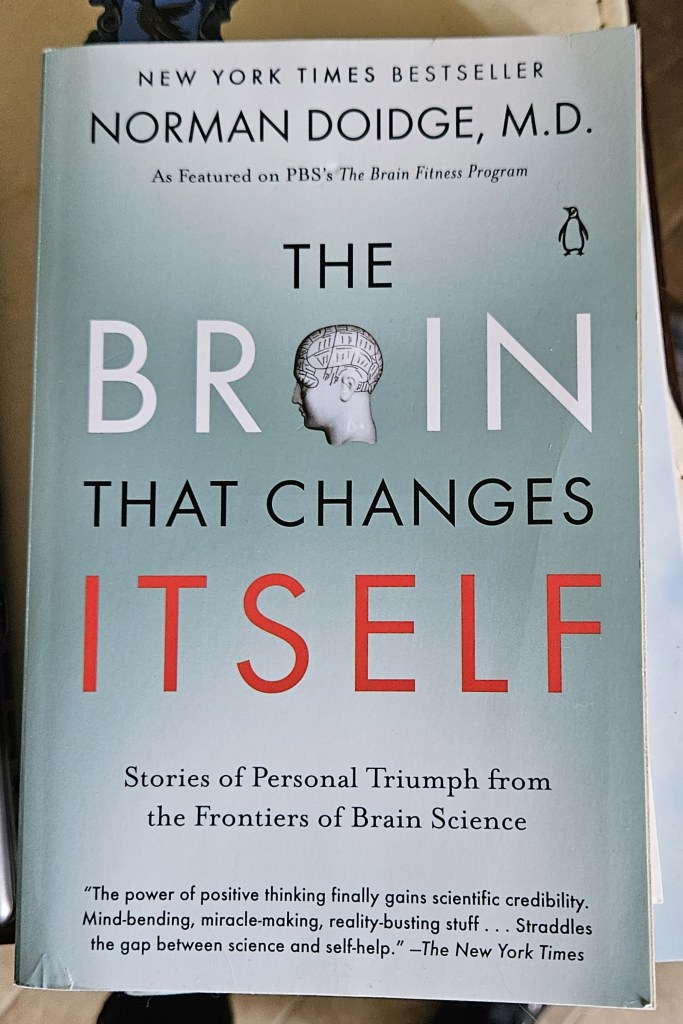
One story that stood out to me was about a man who regained strength and abilities 45 years after suffering a stroke as a child. His story shattered the common belief that recovery has a strict time limit. Chapter 5, which focuses on stroke rehabilitation, introduces the work of the Taub clinics and the Constraint-Induced (CI) therapy principle—techniques that force the brain to rewire by limiting compensation and requiring the use of weaker limbs. These approaches have helped many stroke survivors regain lost functions, proving that healing doesn’t stop after the first few months.
That being said, I wouldn’t necessarily recommend this book to stroke survivors or caregivers looking for direct guidance or comfort. It’s not a practical manual, nor does it offer emotional support in the way My Stroke of Insight does. Instead, it’s for those who are fascinated by the brain’s adaptability. People like me who want to explore the broader science of neuroplasticity will enjoy it.

Reading this book reinforced what I’ve already come to believe—progress is always possible. The brain’s potential for change doesn’t disappear after a set timeline. While this book may not be essential for every caregiver, it’s a powerful read for anyone curious about the science behind recovery and the boundless possibilities of the human brain.

 Beyond Stroke Survival
Leave a comment